
Netflix could throw all the money in the world at a writers’ room and still not come up with this script. Colleagues who once worked under the same roof split up, start rival companies, and within a decade become two of the fastest-growing enterprises in human history — glaring at each other’s launch calendars. Today, let’s recap the saga of OpenAI and Anthropic as if it were a serial drama.
How to watch
What makes this show great is that the two protagonists were originally the same people. Every Anthropic co-founder came from OpenAI. So this isn’t really a story about competitors — it’s a story about siblings who moved out of the family home.
Season 1 (2015–2018) — The Founding Myth of “AI for Humanity”
In December 2015, Sam Altman and Elon Musk join forces to found OpenAI as a nonprofit research lab. The slogan is grand: “AGI must not become the property of any single corporation. It must benefit all of humanity.” With a pledged $1 billion in donations, OpenAI debuts as the ‘good-guy challenger’ to Google DeepMind’s dominance.

The early episodes are slow. GPT-1 ships in 2018 and nobody notices. The real highlight of this season is Elon Musk’s exit. In 2018 Musk leaves the board — officially over conflicts of interest with Tesla’s AI work, though the story that later leaks out is “I offered to run the place and they said no.” A lead actor leaving in season one: classic prestige-TV move.
Season 2 (2019–2020) — The Heel Turn, and the Money Arrives
In February 2019, OpenAI announces GPT-2 and delivers one of the all-time great lines:
“This model is too dangerous to release in full.”
By today’s standards it was an adorably weak model, but the statement split the community in two: genius marketing, or sincere concern? A few months later comes the bigger twist. The self-proclaimed nonprofit creates a for-profit (capped-profit) subsidiary and takes a $1 billion investment from Microsoft. The moment “AI for humanity” became “AI, brought to you by Microsoft.”
GPT-3 lands in 2020 and changes the game. For the first time, ordinary people say “wait, this reads like a human wrote it,” and OpenAI starts selling it as a paid API. But inside the company, a different current is flowing. Dario Amodei, who leads safety research, and his colleagues are growing uneasy about the pace of commercialization.
Season 3 (2021–2022) — The Split, and the Big Bang Called ChatGPT
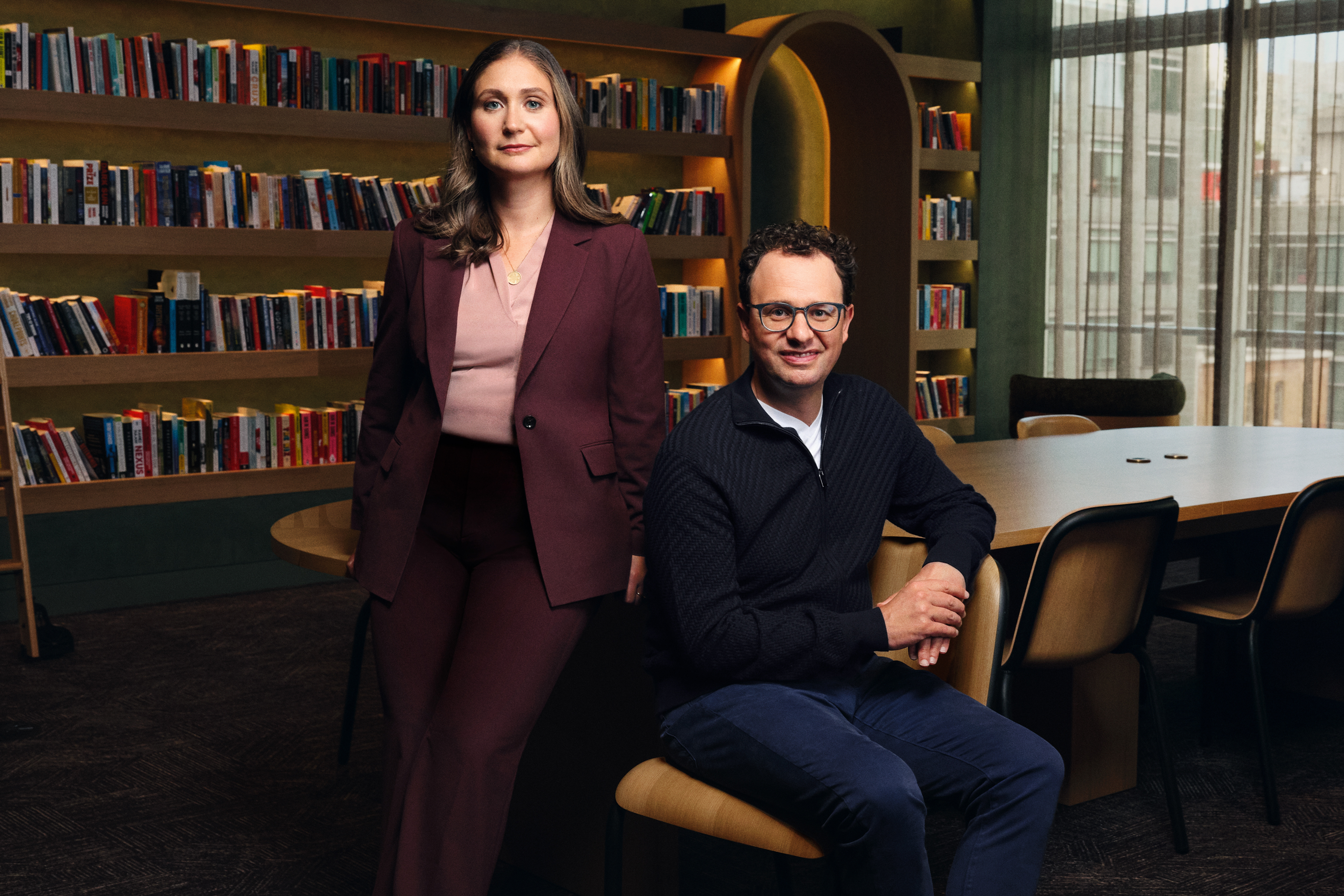
In 2021, the drama’s second protagonist enters. Dario Amodei quits, taking his sister Daniela Amodei and a group of OpenAI colleagues with him, and founds Anthropic. The stated reason is striking: “Before AI gets too powerful, we need to figure out how to make it safe.” It was a declaration of legitimacy — carrying on OpenAI’s founding spirit from outside OpenAI.
While Anthropic quietly builds up safety research like Constitutional AI, OpenAI detonates a bomb for the history books on November 30, 2022: ChatGPT. One million users in five days, 100 million monthly users in two months — the fastest-growing consumer product in history. The funny part? ChatGPT wasn’t even a major new product. It was closer to a demo: the existing GPT-3.5 with a chat UI slapped on top. What changed the world wasn’t the model — it was a chat box.
Behind the scenes
Right after the ChatGPT shock, Google declared an internal ‘code red.’ And one of the counter-moves Google chose was, amusingly, a multi-hundred-million-dollar investment in Anthropic. The enemy of my enemy is my friend — Silicon Valley edition.
Season 4 (2023) — A Same-Day Launch Coincidence, and the Five-Day Coup
March 14, 2023. Write that date down. The very day OpenAI unveils GPT-4, Anthropic releases its first model, Claude. Naturally, GPT-4 takes all the spotlight — next to a report card boasting top-10% bar exam scores, a startup’s first model gets quietly buried. But from this day on, the two companies’ release schedules begin to tangle, each eyeing the other.
In July, Claude 2 shows up holding a 100K-token context window: “We may not be smarter than GPT-4, but we can read an entire book in one sitting.” In September, Amazon raises the stakes with an investment of up to $4 billion in Anthropic.
Then, in November, the single greatest episode of the entire series airs. OpenAI’s board abruptly fires Sam Altman. Fired on Friday; over the weekend, some 700 employees sign a letter saying “if Altman goes, we go”; Microsoft announces “fine, we’ll hire all of them”; and by Tuesday, Altman is back. A palace coup that lasted exactly five days. The most incredible detail: amid the chaos, reports emerged that the board had approached Anthropic about a merger. Dario Amodei turned it down, so it never happened — but if it had, this drama would have ended at season four.
Season 5 (2024–2025) — The Throne Starts to Wobble
In March 2024, Anthropic ships the Claude 3 series and, for the first time, beats GPT-4 on the benchmarks. The formula that had held for over a year — “GPT-4 is still the king” — was broken. OpenAI answers with GPT-4o; three months later Anthropic counters with Claude 3.5 Sonnet. It wins developers’ hearts on coding ability in particular, and this is when the narrative hardens: “GPT for writing, Claude for code.”
In September 2024, OpenAI opens a new front with the reasoning model o1 — “AI that thinks.” In 2025, Anthropic effectively captures the agentic coding market with Claude Code, ushering in the era of an AI that writes and fixes code by itself from your terminal. When OpenAI’s long-awaited GPT-5 arrives in August 2025, expectations are sky-high — which may be why the response amounts to “wait, this is GPT-5?” Meanwhile Anthropic keeps stacking releases — Sonnet 4.5, Opus 4.5 — and keeps growing its enterprise market share.
Which brings us to the money. Look at the two companies’ valuations over time.
| OpenAI | Anthropic | |
|---|---|---|
| 2023 | 29 | 4 |
| 2024 | 157 | 18 |
| 2025 | 500 | 183 |
A 7x gap in 2023 narrows to less than 3x by 2025. A challenger closing that fast is rare in the history of any industry.
Season 6 (2026) — GPT-5.6 vs Fable 5, Now Airing
And then, this year. The first half of 2026 saw the two companies trading punches at two-week intervals.
- April 23 — OpenAI releases GPT-5.5 Thinking / Pro. On May 5, GPT-5.5 Instant becomes ChatGPT’s default model.
- May 28 — Anthropic announces Opus 4.8, adding ‘dynamic workflows’ to Claude Code — a feature that breaks huge problems apart and handles them on its own.
- June 9 — Anthropic shakes the board. Claude Fable 5 and Claude Mythos 5 are announced together: a new ‘Mythos-class’ tier above Opus, with the safeguarded Fable 5 released to the public while the safeguard-lifted Mythos 5 goes only to approved cyberdefense organizations. Pricing: $10 per million input tokens, $50 per million output — exactly double Opus 4.8.
- June 26 — OpenAI counters. GPT-5.6 launches in three versions: Luna / Terra / Sol. Initially, though, it’s a limited preview for roughly 20 government-approved companies.
- June 30 – July 1 — Export controls on Fable 5 are lifted, opening it to users globally.
The new variable in 2026
Season 6’s defining feature is that governments and regulators have formally joined the cast. GPT-5.6 debuted as a restricted release to government-approved companies; Fable 5 went through export controls before going public. Frontier models are now treated like strategic assets — the way semiconductors are.
Model launches are no longer performance pageants; they’re now a game of “how powerful is the thing you built, and how carefully are you willing to release it.” The question both companies posed, in their own ways, a decade ago — “how do you release powerful AI into the world safely?” — is finally facing its real test.
But Is Google Actually Behind?
Watch only this drama and Google — along with everyone else — can feel like an extra. But that’s mostly an optical illusion created by how theatrical these two companies’ story is. Google is, after all, the company that wrote the Transformer paper (“Attention Is All You Need”), and the only full-stack player with Gemini, its own chips (TPUs), and distribution channels like Search and Android. It quietly trades places near the top of the benchmarks, too. Google’s story just happens to lack a fired CEO, estranged siblings, or a five-day coup. A boring plot doesn’t mean a weak player.
Wrapping Up
Ten years, summarized: a nonprofit lab founded on “AI for humanity” became the world’s most valuable startup, and the safety team that walked out of that company built its most dangerous challenger. And in the summer of 2026, the two are holding GPT-5.6 and Fable 5 up to each other’s faces.
Nobody knows how season 7 unfolds. Only one thing is certain: this show has absolutely no plans to end.
Fun fact
The model used to draft this post is none other than Claude Fable 5. That’s right — we asked a cast member to summarize the plot of their own show. One can only hope it didn’t polish its own season a little too lovingly.
Sources
- Introducing Claude Fable 5 and Claude Mythos 5 — Anthropic
- Anthropic releases Mythos-like AI model to the public, Claude Fable 5 — CNBC
- OpenAI releases powerful new GPT-5.6 model under restrictions — Axios
- Introducing GPT-5.5 — OpenAI
- OpenAI releases GPT-5.5 Instant, a new default model for ChatGPT — TechCrunch
- Anthropic releases Opus 4.8 with new ‘dynamic workflow’ tool — TechCrunch